











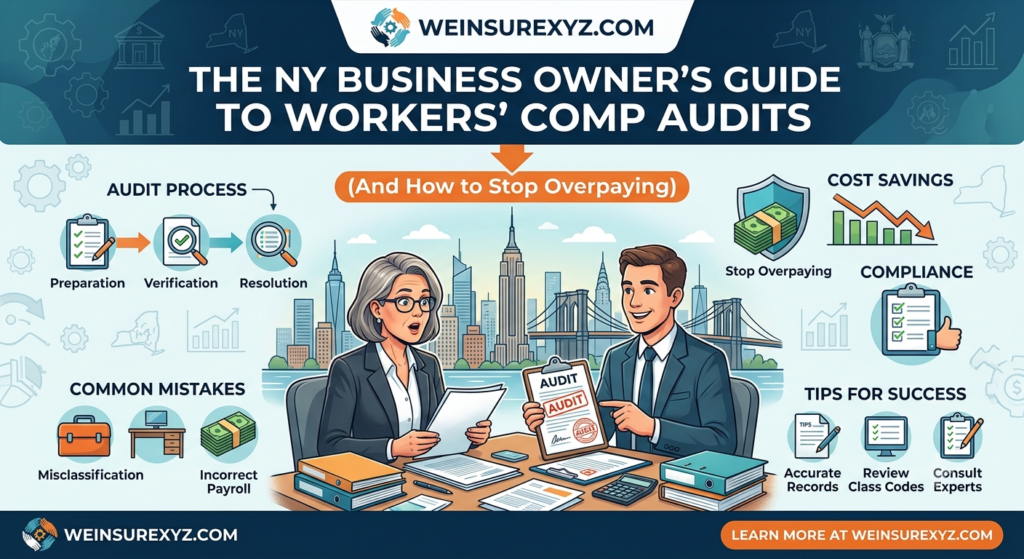
Quick Answer: A workers comp audit is your carrier’s year-end reconciliation of your estimated payroll against your actual payroll and job classifications. In New York, that audit runs on New York Compensation Insurance Rating Board (NYCIRB) class codes — not the NCCI codes used in most other states, which is exactly why generic national guides get NY audits wrong. If your real payroll or risk exposure came in higher than the estimate, you’ll owe additional premium, often as a single bill months after your policy year ends. You have the right to dispute the result, and most brokers never tell their clients that.
The Bottom Line
- A workers’ comp audit compares your estimated payroll at policy inception to your actual payroll and classifications at year-end.
- New York uses NYCIRB class codes and rates, filed annually — not the NCCI system most guides assume. If you operate across state lines, your NY payroll and your NJ or CT payroll are rated under entirely different systems.
- The most common audit triggers: payroll growth beyond estimate, uninsured subcontractors, unreported duty changes, and a rising experience modification rate (EMR).
- You can dispute an audit result through your carrier and, if unresolved, escalate to the NYS Workers’ Compensation Board or NYCIRB directly.
- Preparation starts at policy inception — not when the auditor calls.
What Makes a New York Workers’ Comp Audit Different
Every state runs payroll audits the same basic way: your carrier compares what you estimated to what actually happened, then bills or credits the difference. What catches out-of-state guidance — and a lot of NY business owners who found their broker’s advice online — is that New York is one of only a handful of independent-bureau states. Your class codes, your rates, and your annual rate filings all come from NYCIRB, not NCCI. That matters because NYCIRB updates its loss costs on its own schedule (typically each October), and a class code that looks standard nationally can carry a very different NY rate.
If your business operates in Queens or Brooklyn and you also have crews or locations in New Jersey or Connecticut, this isn’t academic — it means your audit exposure has to be reviewed jurisdiction by jurisdiction. A broker quoting your renewal off a national NCCI table is going to miss it.
What Actually Triggers a Premium Increase at Audit
| Trigger | What Happens at Audit |
|---|---|
| Payroll grew past the estimate | More wages, more premium — even with no other changes |
| Uninsured subcontractors | Their labor (and often materials) get assigned to your policy at your highest applicable class rate |
| Unreported duty changes | An employee shifted into field work, driving, or equipment use without a code update |
| Reclassification to a higher-rated code | The auditor determines the actual primary duty warrants a more hazardous classification |
| Rising experience modification (EMR) | Prior-year claims push your mod factor up, multiplying every dollar of payroll |
These stack. A contractor [VERIFY URL] who grew payroll, moved one worker into field supervision, and used an uninsured sub for even part of the year can see an audit bill several times the original estimate.
The Subcontractor Problem Is the Costliest One
If you can’t produce a valid certificate of insurance (COI) for a subcontractor who worked during your policy period, New York carriers will treat their full payment — labor and materials — as payroll on your policy, rated at the subcontractor’s own class code. This hits general contractors, landscaping companies, and cleaning services [VERIFY URLs] hardest, since all three routinely bring in subs for overflow work. A single uninsured sub on a $150,000 job can generate five figures of audited exposure you never budgeted for.
Records You Need Organized Before the Auditor Calls
- Payroll: quarterly NYS-45 filings, W-2 summaries, overtime broken out by employee
- Classification: written job descriptions, documentation of any duty changes, multi-state payroll split by jurisdiction
- Subcontractors: current COIs for every sub used during the policy period, signed contracts showing independent contractor status
- General: ledger showing all labor costs, time/project records for employees who worked across multiple roles
Any documentation gap gets resolved in the carrier’s favor by default — not yours.
Can You Dispute a NY Workers’ Comp Audit?
Yes. If the auditor misclassified an employee, pulled in subcontractor payroll that had a valid COI, or used incorrect payroll figures, you can challenge it. In New York:
- Request the full audit worksheet from the carrier in writing.
- Compare it line by line against your payroll and classification records.
- Submit a written dispute to the carrier’s audit department with supporting documentation.
- If unresolved, escalate to NYCIRB for classification disputes or the NYS Workers’ Compensation Board for coverage disputes.
Most disputes are resolved in the policyholder’s favor when the documentation is complete — the businesses that never dispute are usually the ones who assumed the number was final. It isn’t.
Your Experience Modification Rate Makes This Worse (or Better)
Your EMR is a multiplier on your base premium based on claims history. A 1.0 is average; above that, every dollar of audited payroll gets multiplied by a worse factor. This is where claims prevention [VERIFY URL] and how you handle open claims compounds directly into audit outcomes — a payroll increase revealed at audit hits much harder if your mod is already elevated. If you’ve had a non-renewal notice tied to claims history, our breakdown of NY Insurance Law §3425 non-renewal protections [VERIFY URL] covers your rights there.
Industry-Specific Audit Risk in NY
Audit exposure looks different depending on what you do. A few of the patterns we see most in Queens and across the five boroughs:
- Trucking [VERIFY URL]: driver reclassification and owner-operator vs. employee disputes are the most common audit surprise.
- Staffing agencies [VERIFY URL]: client-site payroll and multi-worksite classification make this one of the most audit-heavy verticals in NY.
- Restaurants [VERIFY URL]: tipped wage reporting and kitchen vs. front-of-house classification splits are frequently audited.
- Pharmacies [VERIFY URL]: pharmacist vs. technician vs. clerical classification splits matter more than most owners realize.
How to Actually Prepare (Not Just Survive) Your Next Audit
- Confirm class codes match real job duties at policy inception
- Collect and renew subcontractor COIs continuously — set calendar reminders, don’t wait for the audit request
- Document every employee duty change in writing as it happens
- Flag payroll growth of 15%+ to your broker mid-year and request an interim endorsement
- Ask about a pay-as-you-go program, which bills against actual payroll each period instead of an annual estimate
How Weinsurexyz Handles the Audit Cycle Differently
Most brokers hand you a policy and reappear at renewal. We treat the audit as a cost-control checkpoint, not a formality: reviewing class codes at inception, flagging COI gaps mid-year, and building the dispute file if a result doesn’t hold up. If you’re comparing brokers on this, our comparison of NY workers’ comp brokers walks through what to look for beyond price.
For a full view of how workers’ comp fits into your broader NY coverage picture, start with our New York business insurance hub [VERIFY URL] or go straight to our NY workers’ compensation insurance page [VERIFY URL].
Frequently Asked Questions
Does New York use NCCI class codes?
No. New York is an independent-bureau state — class codes and rates are filed by NYCIRB, not NCCI. If you operate in multiple states, each jurisdiction’s payroll gets rated under that state’s own system.
How long do I have to dispute a NY workers’ comp audit?
Disputes are typically handled first through the carrier’s audit department, with escalation available to NYCIRB (classification disputes) or the NYS Workers’ Compensation Board (coverage disputes) if unresolved at the carrier level.
What happens if I ignore an audit request?
The carrier will complete an estimated audit using assumptions that favor them, almost always resulting in a higher bill than an accurate audit would. Non-response can also affect renewal terms.
Do uninsured subcontractors really get added to my payroll?
Yes. Without a valid COI on file, the full amount paid to that subcontractor — not just labor — is typically treated as payroll on your policy at their applicable class rate.
Book a policy review with Weinsurexyz before your next audit cycle, and we’ll walk your class codes, COI file, and EMR trend line before the carrier does.
