Term vs. Whole Life Insurance At a Glance
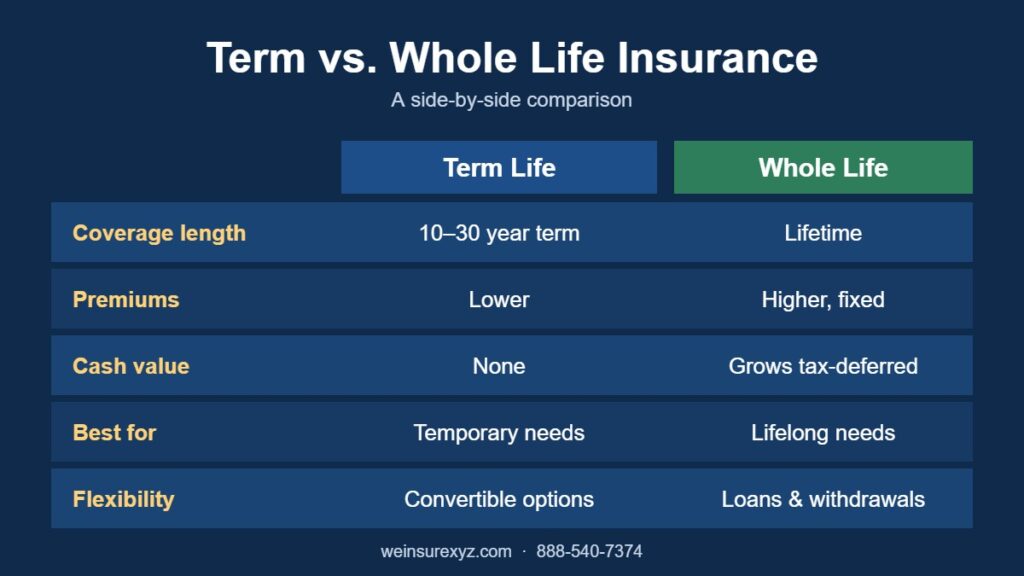
The most common options you’ll see when shopping for life insurance are term life and whole life. While both provide coverage if you should pass away, there are critical differences between the two. Term life insurance is a temporary policy that will cover you for a set number of years — also known as the term. Term policies also offer no monetary value other than the death payout.
Whole life insurance, on the other hand, is a permanent policy that will last as long as you are alive and provides a cash value that can be accessed while you are living.
Term policies are often sold in terms of 10–30 years. During that time, if you should pass away, the policy would pay an amount of money — known as the death benefit — to your beneficiary. However, after that term expires, the policy may end or rise in price drastically.
Plan for your family’s future. Get a life insurance quote today.
Or call 888-540-7374
Coverage for Now and Later — Finding the Right Type of Life Insurance for You
When someone passes away prematurely, it can cause financial strain for their loved ones. Life insurance is intended to provide your beneficiaries with financial security, should that happen. As of 2021, approximately 260 million Americans have some sort of life insurance.
Those without life insurance may be more at risk of leaving debt — such as medical bills, final expense costs, and mortgage expenses — behind. Whether it is a term or whole life policy, a payout from a life insurance policy could significantly lessen the financial burden for your loved ones.
Term Life vs. Whole Life Insurance
What Is Term Life Insurance?
A term life insurance policy is a type of life insurance that typically only lasts for a set number of years. Most term policies are sold for terms between 10-30 years. After the term is up, the policy can either renew (usually at a much higher rate) or end. If the insured should pass away during the term period, the policy would pay out a death benefit. However, if the insured passes away after the policy ends, there would be no payout.
Types of Term Life Insurance Policies
When looking for a term life policy, there are several different types to consider, such as level term, convertible term, decreasing term, return of premium, renewable term, and annual renewable term. It is possible that a policy can combine more than one type of term insurance. For example, a policy may be both level and convertible term.
Level Term
A level term policy is a policy that provides a death benefit and premium that do not change during the term period. For example, if a 20-year term policy is purchased with a death benefit of $50,000 at $50 per month, neither the premium nor the death benefit will change during the initial 20-year period. However, the policy premium may increase after the initial term, or the death benefit may decrease.
Convertible Term
A convertible term policy refers to a term policy that allows the policy to be changed or converted from a term policy into a permanent policy. The conversion option may not last the entire term of the policy and may not be included on all term policies.
Decreasing Term
A decreasing term policy offers a death benefit that decreases over time. These policies may be used to cover an expense, such as a mortgage or loan, whose balance decreases over time. By the end of the term, the death benefit will reach zero, and the policy will end.
Return of Premium
A return-of-premium (ROP) term policy is usually a level term policy that will return all of the premiums to the insured at the end of the term if the insured is still alive. For example, if a customer purchases a 20-year ROP and pays $10,000 in premiums, at the end of the 20-year term, they would be able to cancel the policy and receive their premiums back.
Renewable Term
With a renewable term policy, the policy will renew at the end of the term instead of canceling. However, the price will increase, sometimes significantly, at each renewal. For example, a policy may be a level term for the first 20-year period but then will renew at a higher price every 5 years thereafter.
Annual Renewable Term
An annual renewable term works just like a renewable term except that it renews much more often. These policies renew yearly, meaning the policy stays in effect one year at a time. However, the price will increase every year and may reach a premium that becomes too expensive for you to keep.
What Is Whole Life Insurance?
Whole life insurance is different from term in that it is a permanent policy designed to last your entire life, as long as the premiums are paid. It also offers a cash value in addition to a death benefit; the cash value grows as the premiums are paid, and you can access it during the policy period.
Types of Whole Life Insurance
When considering whole life as an option, it is important to know that there are several different types of whole life insurance, from a traditional policy to a variable policy. While most types of whole life policies are very similar, there are some differences to consider.
Traditional Whole Life
A traditional whole life insurance policy is the most common type of whole life insurance. This type of whole life insurance provides a death benefit, the amount paid to the beneficiary if the insured should pass away. It also builds a guaranteed cash value that you can access for any reason.
When a premium payment is made, a portion of the payment covers the death benefit, and another portion goes into the cash value. A set interest rate is then paid on the premiums in the cash value account.
Most life insurance companies also pay dividends — a share of the company’s profits returned to policyholders — which can help the cash value account grow. While annual dividends are not guaranteed by most companies, many reputable companies pay them regularly. Among permanent policies, a traditional whole life offers the most guarantees and stability.
Universal Life
A universal life insurance policy is another type of permanent life insurance that consumers can consider when looking for a policy. While universal life policies are not a type of whole life policy, they are permanent policies that may perform similarly to a whole life policy.
A universal life policy has more flexibility than a whole life policy; the death benefit, premiums, and length of the policy can all be adjusted, while a traditional whole life policy cannot. A universal policy has the potential to accumulate a cash value, but it is not guaranteed.
While the policy does offer flexible premiums, if the policy becomes underfunded, it can run out prematurely, leaving you with no life insurance. A universal life policy offers a guaranteed death benefit, as long as the policy is funded correctly, and the possibility of earning a cash value.
Variable Whole Life
A variable whole life insurance policy works similarly to a traditional whole life policy. A variable whole life policy provides a death benefit and a cash value account. On a traditional whole life policy, the interest is paid at a set rate. However, on a variable whole life policy, the interest can vary because the cash value is invested in different accounts, often mutual funds.
The interest paid on the cash value depends on how well those accounts perform. While there is the possibility that the policyholder can earn more than on a traditional whole life, there is also the possibility that the cash value can drop. Most variable whole life policies also offer a fixed interest option. If this is the case, the policyholder may be able to divide their cash value between the fixed account and the variable account.
While a variable life policy offers the possibility of the biggest return, it is also the riskiest of permanent policies.
Indexed Universal Life
Like a universal life policy, an indexed universal life policy (IUL) is not a type of whole life. It is a permanent policy that will provide a death benefit and can accumulate a cash value. An indexed universal life policy works similarly to a universal life policy. Many features, such as premiums and death benefits, are flexible.
With an IUL policy, any funds that accumulate in the cash value account are invested in a stock market index account, such as the S&P 500. The cash value account will be linked to that stock market account. That allows the policyholder to earn more than the set interest rate of a whole life policy, but they could also earn no interest if the indexed account does not perform well.
IUL policies usually offer a guaranteed minimum interest rate and a maximum cap rate. For example, if an IUL offers a cash value account at 0-8%, the interest paid will never be less than zero, but never more than 8%. If the indexed account the policy is linked to performs at 10%, the policy will only be credited the 8% maximum. If the indexed account finishes at -10%, the policy will not lose any money, but it will not gain anything either.
Because of the caps placed on IUL policies, they are less risky than a variable whole life policy but offer fewer guarantees than a traditional whole life policy.
Guaranteed Issue Whole Life
A guaranteed issue whole life policy is a policy typically designed for people with medical issues who cannot get other life insurance. These policies usually have little to no underwriting requirements and are guaranteed to issue, but usually aren’t available until you reach a certain age (usually 50). While these policies may be a great option for those with major medical issues, they may be much higher in premium than other permanent policies and are usually only offered at limited coverage amounts, typically between $5,000 and $25,000.
Another factor to consider is that these policies often have a waiting period, usually 2-3 years, before the death benefit will be paid out. If the policyholder should pass away during the waiting period, the beneficiary would not receive the death benefit. However, some life insurance companies will pay the beneficiary any premiums that have been paid into the policy plus interest.
While a guaranteed issue policy may gain cash value and accumulate annual dividends, it is not likely that the return will be as much as a traditional whole life policy. These policies are designed for older people who cannot acquire another form of life insurance.
Term vs. Whole Life Insurance: Eligibility
When it comes to applying for a life insurance policy, consumers should consider what will be required to obtain the policy and whether they will be eligible to purchase a certain type of policy. Life insurance, in general, may be denied to an individual who is in bad health, has a high-risk job, or does not meet the company’s criteria.
Certain policy types may have more strenuous guidelines than others. It is important to note that guidelines can vary widely from company to company.
Term vs. Whole Life Insurance: Policy Length
When choosing between a term or whole life policy, you need to consider how long you want the policy to stay in force.
Term vs. Whole Life Insurance: Premiums
When looking for a life insurance policy, one of the most common concerns is premiums, or how much you will have to pay each month to keep the policy in force. While cost is a main factor, it is important to know why some policies have higher premiums than others.
Term vs. Whole Life Insurance: Coverage Amount
When choosing a life insurance policy, it is important to know how much coverage is needed. Some policies may only need to cover a specific debt, such as a mortgage. Others may need to cover not only debt, but also end-of-life expenses, childcare, etc.
It is possible to combine policies to meet needs. For example, if an individual needs $500,000 in coverage, but cannot afford a whole life policy for the full amount, it is possible to split it into two or more policies, such as a term for $400,000 and a whole life for $100,000. The coverage limits of a policy can vary from company to company.
Term vs. Whole Life Insurance: Investment
One main difference between whole life insurance and term insurance is the return on premiums. While term life offers little to no return on premiums, whole life will offer a guaranteed cash value as well as a possible dividend. You can access the cash value of your whole life policy at any time for any reason. The cash value can be used for unexpected debt, emergencies, or any reason you choose.
You can also choose to take a loan from the policy. What this means is that you can take a portion of the cash value, usually up to 90%, in the form of a loan. Although this amount does not have to be paid back, it will accrue interest, which can increase the amount of the loan over a period of time. If the insured passes away with an outstanding loan on their policy, the loan amount is deducted from the death benefit.
Term vs. Whole Life Insurance: Flexibility
Some consumers may look for a policy that offers flexibility over time. While a universal life policy offers the most flexibility, it is possible to get some flexibility in other types of life insurance. For example, while a term policy does have a set price and death benefit, some types of term policies will allow the policyholder to convert all or part of their coverage to a permanent plan.
This allows policyholders to purchase a larger term policy now with the plan to convert it into a smaller whole life policy down the road. However, whole life policies offer little to no flexibility. They are purchased at a set coverage for a set price.
Term vs. Whole Life Insurance: Sustainability
While it is important to consider the circumstances of your life today, such as budget and coverage needs, it’s good to keep the long-term goal in mind. Although term may be a more affordable option now, it may become unsustainable long-term due to increasing premiums. It’s also possible that a term policy may expire before you pass away — leaving you with no life insurance.
Advantages
Term Life
Term life may not be the best choice for everyone, but it does have some key advantages.
- Affordable premiums: Premiums on term policies are typically much lower than whole life policies for the same amount of coverage. This is attractive to those who may need a larger amount of coverage on a tighter budget.
- Flexible coverage: Term policies allow consumers to choose how long their coverage will last, allowing the policyholder to have flexibility if they only need a policy for a certain amount of time. Often, it is possible to convert the term policy to a whole life policy.
- No investment risk: While a term policy does not offer any returns on premiums, there is also no risk of losing any money due to investment. The premiums are used to cover the death benefit and are not invested otherwise.
- Straightforward policy: A term policy is simple to understand. An insured will pay a specific premium for a set number of years. If they pass away during that term, their beneficiary receives a payout. There is no cash value or investment component to understand.
Whole Life
While whole life may not be the best choice for some, there are many advantages to consider.
- Lifetime coverage: Whole life policies offer coverage for your entire life. As long as the premiums are paid, the policy will stay in force.
- Level premiums: The premiums on a whole life policy will not change. This allows the insured to plan their budget and not have to worry about the premiums increasing.
- Cash value: A whole life policy offers a cash value component that is an attractive feature to many consumers. This allows them to have not only death benefit coverage but also access to a cash value should they need it.
- Tax advantages: Not only is the death benefit paid to the beneficiary tax-free, but the cash value of the policy also grows tax-deferred. This means that while the policy value is growing, it is not taxed. When the policyholder accesses the cash value of the policy, only the gains are taxed. For example, if the policyholder paid $5,000 into a policy and withdrew $8,000, only the $3,000 gain would be taxed.
Drawbacks
Term Life
Although term policies have many advantages, there are some drawbacks as well.
- Temporary coverage: A term policy will only last for a set number of years. After the term is over, the policy may end or renew at a much higher cost.
- Increasing premium: Unlike a whole life policy, a term policy’s premiums may increase. While the price may be level during the initial term, policyholders may see a significant increase afterward.
- No cash value: A term policy is not designed to provide a cash value to the insured. Rather, it simply provides a death benefit should the insured pass away during their term.
- No lifetime coverage: Although term policies may be offered with terms of up to 30 years, it is not guaranteed that the policy will last the entire lifetime of the insured. It is possible that the term policy may end, leaving the insured without life insurance coverage.
Whole Life
Whole life insurance has many advantages to consider, but there are some disadvantages as well.
- Higher premiums: Compared to a term policy for the same coverage, a whole life policy may be much higher in cost.
- Less flexibility: With a whole life policy, there is no way to change the policy into another type of policy. Should you decide you want to change to a term policy, you would have to cancel the whole life and reapply for a new policy.
- No guaranteed dividends: While a whole life policy offers a guaranteed fixed interest rate to establish a cash value, there is no guarantee that a policy will pay a dividend. Dividends often help boost the cash value of a policy and are often paid but cannot be guaranteed.
- No investment diversification: While a whole life policy does offer a return on premiums in the cash value, it is not designed as an investment vehicle. They often have limited investment options, and the policyholder’s control over investment decisions is minimal.
How to Get It: Term or Whole Life Insurance
After you decide what type of policy is best for you, it is time to make a purchase:
- Look at insurer details. This includes financial stability and years in business.
- Obtain quotes from several companies and compare. Look at premiums, length of term, return on premiums, and more.
- Apply for a policy. Each company’s process may be a little different, but the steps should be similar. You will need to contact the company and provide some information to fill out an application. This may vary from basic information, such as name and date of birth, to more detailed information, such as health and job details.
- Complete underwriting, if applicable. Once the application is submitted, the insurance company will then continue with the underwriting process, which may include medical questions or a medical exam. The more coverage you apply for, the more rigorous the underwriting process can be.
- Await decision on coverage. When the underwriting process is completed, the insurance company will make a decision to either approve or deny you. It is possible that you will be approved, but at a higher rate than quoted. If you’re approved, the policy will be issued as planned. If denied, you may need to apply for a different type of policy, or may not be able to purchase life insurance altogether. If this happens, you can consider simplified issue or guaranteed issue options instead, which have more flexible acceptance criteria, though often at a higher cost.
Parting Thoughts
Whether it is a term or whole life policy, it is important that you find a life insurance policy to cover your individual needs. It’s necessary to have adequate coverage in place so your loved ones are financially set in the event of your death. Although both types of policies offer a death benefit, there are many differences. Understanding the differences will help you make a well-informed decision.
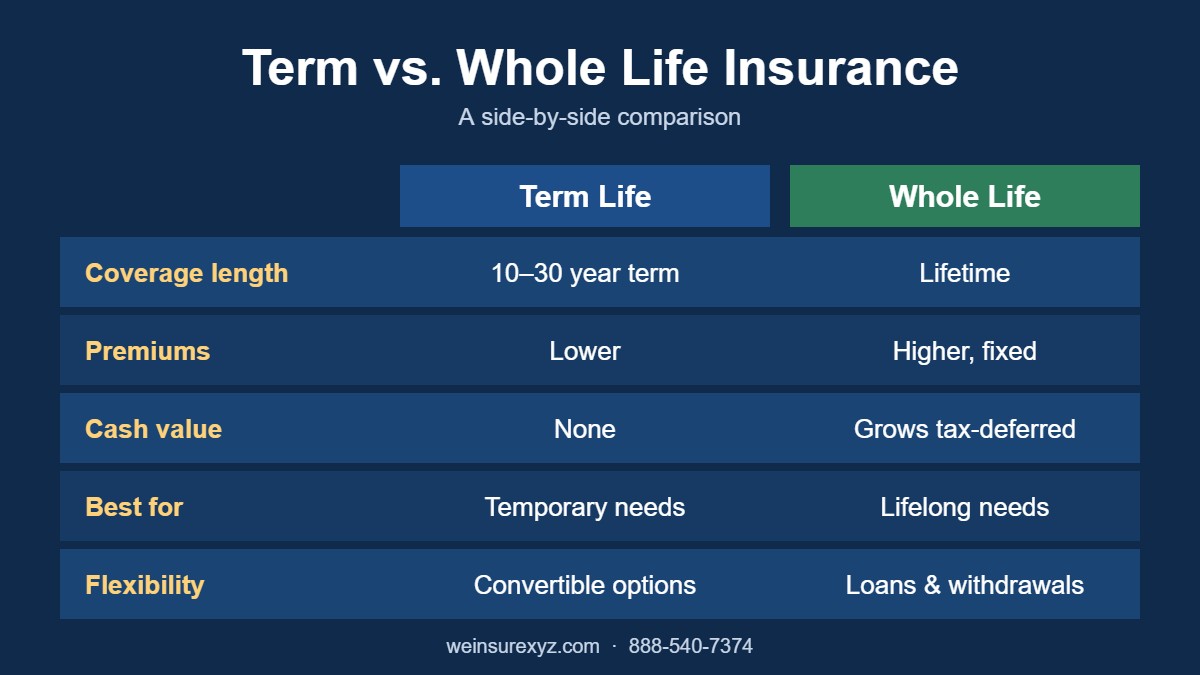
A term policy may be best if having a lower premium and flexibility is most important to you. If having a set premium and lifetime coverage is most important, then a whole life policy may be better.
Plan for your family’s future. Get a life insurance quote today.
Or call 888-540-7374
